Time blocking techniques that actually boost daily productivity
A client once told me she had "no time" to finish a report. We looked at her calendar together. Her Tuesday held eleven separate meetings, none longer than twenty-five minutes, and between each one she had a gap of eight to twelve minutes. She'd been treating those gaps as free time. They weren't. They were the reason the report never got written.
That's the whole problem in miniature: your day isn't short, it's fragmented. Time blocking is the practice of assigning a specific chunk of your calendar to a specific kind of work, instead of letting tasks float around waiting for a convenient hole. Sounds obvious. Almost nobody does it right.
Here's the thing, though — most articles stop at "put everything on your calendar" and call it a day. That advice collapses the moment a colleague books over your block. So below, I'll walk through the techniques that survived contact with real workloads: the named rules people keep asking about, how to adapt them to your actual job, and where I've watched people (including myself) get it wrong.
Key takeaways
- Time blocking works because it converts vague intentions into calendar commitments — but only if you defend the blocks.
- The 3-3-3, 1-3-5 and 7-8-9 rules are all just different shapes of the same idea: cap how many things you promise to do in a day.
- Nothing named after a billionaire is a method. It's a headline.
- Buffer time is not optional. It's the load-bearing wall of the entire system.
- Track your task-switching for three days before you change anything. The numbers will tell you where the leak is.
What time blocking actually changes
Most productivity advice fails for the same reason diets fail: it asks you to change a behaviour without changing the environment around it. Time blocking is different because it changes where your tasks live. They stop existing as a list and start existing as appointments.
An appointment with yourself has a strange psychological weight. When I first tried this, I'll admit, I assumed it was theatre. Who respects a meeting titled "Write Q3 summary"? Turns out, I did — most of the time. Roughly eight out of ten of my morning blocks survived the week. The two that didn't taught me more than the eight that did, which I'll get to.
The switching tax you never see
Every time you jump between tasks, you pay a toll. Part of your attention stays stuck on the last thing. Researchers who study cognitive load call it attention residue, and the practical effect is that the first several minutes of any new task are slower and worse than the minutes in the middle.
Count your context switches tomorrow. Not the tasks — the switches. A day with fifteen switches loses something in the range of one to two hours to restart costs. That's not a rounding error. That's your afternoon.
Why your to-do list is lying to you
A list has no size. Fifty items look the same as five. A calendar, by contrast, has hard edges — a day holds roughly eight to ten usable hours, and if you try to fit twelve into it, something breaks visibly.
That visibility is the point. It's the difference between a budget and a wish.
The named rules, explained properly
People keep searching for these because the names sound like secrets. They aren't secrets. They're portion control.

What is the 3-3-3 rule of productivity?
The 3-3-3 rule says you should aim to spend roughly three hours on deep, focused work, handle three shorter or lighter tasks, and make contact with three people — a call, a message, a quick check-in — each day. The idea is to spread your effort across three different modes of work rather than pouring everything into one.
It's a decent structure for people whose jobs mix solo work with coordination. It's close to useless if you're a developer mid-sprint, because your "three shorter tasks" will eat the morning you needed for the hard one. In my experience it fits founders, consultants and anyone whose day genuinely straddles several roles.
What is the 1-3-5 rule in time management?
Under the 1-3-5 rule, each day gets one large task, three medium tasks and five small ones. That's nine items, maximum. Anything beyond that moves to tomorrow without negotiation.
The arithmetic matters more than the rule. A "large task" typically needs two to four hours, a medium one around thirty to sixty minutes, a small one under fifteen. Add it up and you get a day that's full but not fictional. I used this for about four months on a project with a brutal deadline and it was the only thing that kept me from over-committing every single morning.
The failure mode? People pick a large task that's actually three large tasks wearing one hat. Be honest about the size.
What is the 7-8-9 rule for time management?
The 7-8-9 rule is a daily-life version of the same idea: aim for seven hours of sleep, eight hours of work, and nine hours for everything else — family, health, rest, the parts of life that don't invoice anyone. It's less a scheduling technique and more a boundary-setting one.
I'm sceptical of the exact figures, because an eight-hour workday plus commute plus meals doesn't leave nine honest hours for living. But the underlying argument holds: if you don't allocate the non-work hours first, work will absorb them silently, and you'll wonder where the week went.
What is Elon Musk's time management method?
It's usually described as dividing the day into five-minute slots and moving relentlessly between them. The published accounts of how Musk schedules his time involve very short blocks and a heavy reliance on delegation.
My honest read: it's a terrible model for most people, and I'll defend that position. Five-minute blocks only work if someone else is handling the follow-through on almost everything you touch. For a knowledge worker who has to finish the thing they started, five-minute fragments produce exactly the scattered day my client had — the one where the report never gets written. Take the principle (short blocks for shallow work) and drop the number.
How the rules compare in practice
| Rule | What it caps | Best suited to | Main risk |
|---|---|---|---|
| 3-3-3 | Three modes of work per day | Mixed-role jobs: founders, consultants, team leads | Vague on task size, so days still overflow |
| 1-3-5 | Nine tasks total, by size | Project-driven individual work with clear deliverables | People misjudge what counts as "large" |
| 7-8-9 | Hours across sleep, work, life | Anyone losing evenings to work creep | Arithmetic rarely survives a real commute |
| Five-minute blocks | Slot length | Executive roles with heavy delegation | Destroys focus for people who must finish work themselves |
Notice what they share: every one of them is a limit. None of them tells you what to add. That's the actual mechanism, and it's why picking any one of them and sticking to it beats sampling all four.
Building blocks that survive a real week
Here's the part most guides skip. A block on a calendar is a hypothesis about how your day will go. Most hypotheses are wrong the first time.
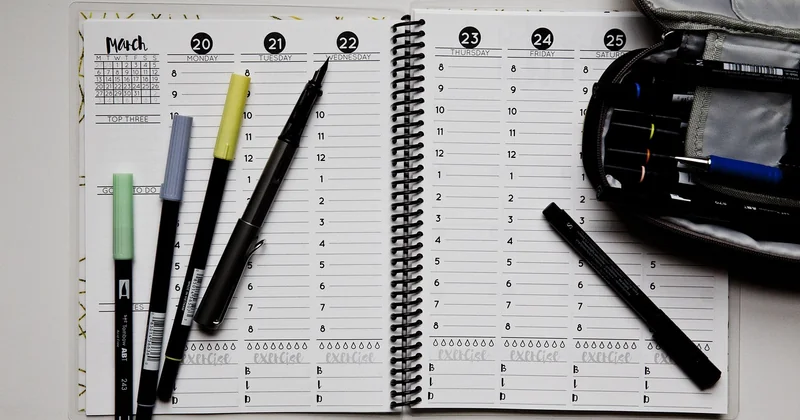
Start by measuring, not planning
For three working days, write down what you actually did in half-hour increments. Don't change anything yet. Just record.
When I did this the first time, I discovered that about 40% of my "work" time was spent in my inbox and chat, and that my genuinely productive stretch was a 90-minute window starting around 9:20am. I'd been spending that window in meetings because that's when everyone else was available. Rearranging that one thing bought me more than any app ever has.
Build the weekly template first
Don't block tomorrow. Block the week. Recurring blocks for recurring work, then adapt daily as reality interferes.
- Mark your fixed commitments — meetings, school runs, anything immovable.
- Place your deep-work blocks in your best cognitive window, not your most convenient one.
- Add a 15-minute buffer after every meeting.
- Reserve one block per day for the shallow pile: email, admin, approvals. One, not five.
- Leave roughly 20% of the week unassigned on purpose. You will need it.
That fifth step is the one people skip, and it's the one that makes the system hold. A fully blocked calendar is a fragile calendar.
Make the blocks defensible
A block titled "Work" will be overridden. A block titled "Draft proposal — do not book" mostly won't. Naming your blocks changes how other people treat them, and frankly, how you treat them too.
One practical trick: set your calendar's default meeting duration to 25 minutes instead of 30. Over a week, that habit quietly returns a couple of hours without anyone noticing they gave them up.
Adapting time blocking to your job
This is where generic advice falls apart, because the right structure depends entirely on how interruptible your work is.
If you write code or produce long documents
You need blocks of at least 90 minutes, ideally two hours. Shorter than that and you spend the whole block reloading context. Two such blocks a day is a strong day. Three is exceptional.
If you manage people
Your day is genuinely interruptible, so fight for the opposite: cluster your meetings into two windows, and protect one uninterrupted block in the morning for the work only you can do. I've watched managers try to hold a full deep-work afternoon and fail within a fortnight, because their team needs answers.
If you freelance
Block client work in one colour and business development in another. The second one is the block that dies first when a deadline approaches, and it's the one that keeps you solvent three months later.
If your team spans time zones
Anchor your blocks to your own best hours and let the overlap window be for collaboration only. A distributed team that blocks by local peak hours gets more done than one that forces everyone into a shared window that suits nobody.
Where time blocking fails
Three failure modes, and I've committed all of them.

Overstuffing. Early on I'd schedule six hours of deep work into a day that also had four meetings. By Wednesday the whole calendar was fiction and I stopped trusting it entirely. A calendar you don't believe in is worse than no calendar.
No buffers. Back-to-back blocks mean one overrun destroys the rest of the day. Fifteen minutes between blocks is the cheapest insurance you'll ever buy.
Treating the plan as sacred. Plans break. The skill isn't preventing disruption, it's deciding in ten seconds what to move and what to sacrifice. I keep a note on my desk that reads: "What gets dropped today?" It sounds dramatic. It works.
Do you need an app for this?
No. A calendar you already have is enough. Apps help with recurring templates and time tracking, and if you're managing several projects with billed hours, one is genuinely worth it. If you're starting out, adding a tool just adds a place to procrastinate. I've seen more people succeed with a paper week-grid than with a subscription.
How long before it feels natural?
Give it three weeks. The first week feels rigid, the second feels like admin, and somewhere in the third the blocks start doing the deciding for you. That's when it stops being a technique and becomes a habit.
The question worth keeping
Here's what I keep coming back to. Time blocking doesn't make you more productive by filling your day. It makes you more productive by forcing you to admit how little your day actually holds — and then deciding, on purpose, what gets the space.
That's an uncomfortable calculation. Most people avoid it by keeping the list long and the calendar vague. But the colleague who seems calm isn't working faster than you. She just decided last Sunday which four things matter, wrote them down as appointments, and let the other thirty wait.
So before you download anything or redesign your week: pick your three rules, block tomorrow morning, and see what happens when someone tries to take the block away. What you do in that moment tells you whether the system is real.